AWS Amplify + ECS – Scalable & Secure Decoupled Application Architecture
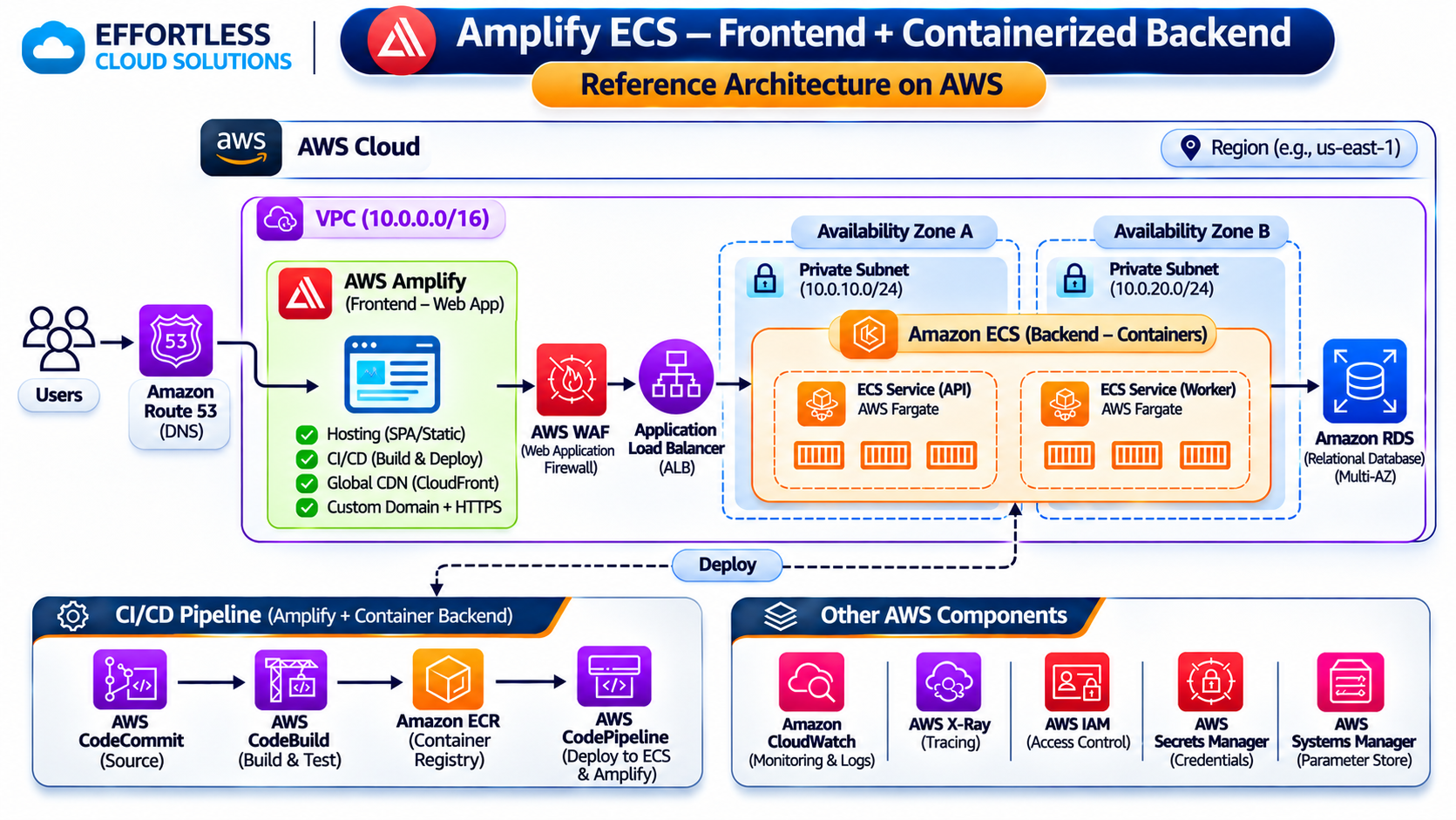
Hosting the frontend on AWS Amplify and running the backend API on Amazon Elastic Container Service (Amazon ECS) gives teams a secure, highly available, and automatically scaling full-stack platform. Static and server-rendered pages are delivered from a global edge network, the API runs in private containers behind an Application Load Balancer, and both layers are protected by AWS WAF, with secrets, certificates, and access managed centrally.
Benefits
uptime, backed by multi-AZ task placement and ECS automated recovery
faster deployment speed with automated blue/green pipelines
improvement in engineering team efficiency on AWS Fargate
Pages and assets served from a global CDN with Git-based builds and instant cache invalidation
API containers spread across multiple Availability Zones behind an Application Load Balancer
Frontend scales automatically on Amplify; backend tasks scale out and in with demand
AWS WAF on both layers, private subnets, and secrets stored in AWS Secrets Manager
Independent CI/CD for frontend and backend, with preview environments and zero-downtime deploys
No servers to manage for either layer when the backend runs on AWS Fargate
Overview
Many web applications are deployed as a single server that hosts the frontend, the API, and sometimes the database together. Every frontend change requires redeploying the whole application, static assets are served from one location far from many users, credentials are stored in configuration files on the server, and the application is exposed directly to the internet with little protection. One failure or traffic spike takes the entire product offline.
Splitting the application into an AWS Amplify frontend and an Amazon ECS backend solves these problems. Amplify builds and hosts the frontend from Git and serves it worldwide through its built-in content delivery network. The backend API is containerized and runs on AWS Fargate in private subnets behind an Application Load Balancer. AWS WAF filters malicious traffic before it reaches either layer, AWS Secrets Manager supplies credentials at runtime, and Amazon CloudWatch monitors the full stack. Each layer can be released, scaled, and secured independently.
About AWS Amplify and Amazon ECS
AWS Amplify Hosting is a fully managed service for building, deploying, and hosting web frontends, including single-page applications built with React, Angular, or Vue and server-side rendered frameworks such as Next.js. It connects directly to a Git repository, builds every commit, creates preview environments for pull requests, and serves the site through a global content delivery network with custom domains and free SSL/TLS certificates. Amazon Elastic Container Service (Amazon ECS) is a fully managed container orchestration service. Combined with AWS Fargate, it runs containerized backend services without provisioning or patching servers, integrates natively with Elastic Load Balancing, AWS Identity and Access Management (IAM), AWS Secrets Manager, and Amazon CloudWatch, and scales tasks automatically based on demand.
Opportunity: Separating a Tightly Coupled Application
When the frontend and backend share one server, they share every weakness. A small change to a button or a page layout requires a full application redeploy. Users far from the server experience slow page loads because there is no edge caching. A spike in API traffic slows down page delivery, and a single instance or Availability Zone failure takes down the whole product.
Security is often an afterthought in these setups. Database passwords and API keys sit in environment files on the server or in source code, the application and database may be reachable from the internet, and there is no web application firewall to block common attacks such as SQL injection, cross-site scripting, or bot traffic.
Organizations in this position need an architecture that lets frontend and backend teams release independently, delivers pages quickly to users everywhere, keeps the API and data private, and applies consistent security controls across the full stack.
The Solution
Frontend on AWS Amplify Hosting
The frontend repository is connected to Amplify Hosting. Every push to a branch triggers an automatic build and deployment, and each branch (for example, development, staging, and production) gets its own environment. Pull request previews let reviewers test changes on a live URL before merging, and failed builds never replace the live site.
Global Content Delivery
Amplify serves the frontend through its built-in Amazon CloudFront-based content delivery network, caching static assets close to users and invalidating the cache automatically on each deployment. Server-side rendered pages for frameworks such as Next.js are handled by Amplify without separate infrastructure.
Custom Domains and Certificates
Amazon Route 53 hosts the domain. The frontend is served at the main domain (for example, app.example.com) through Amplify, and the API at a subdomain (for example, api.example.com) through the Application Load Balancer. AWS Certificate Manager (ACM) provides and automatically renews the SSL/TLS certificates for both.
Backend API on Amazon ECS with AWS Fargate
The backend is packaged as a Docker image, stored in Amazon Elastic Container Registry (Amazon ECR) with scan-on-push enabled, and deployed as an ECS service on AWS Fargate. Tasks are spread across at least two Availability Zones, and unhealthy tasks are replaced automatically.
Application Load Balancer
An internet-facing Application Load Balancer in public subnets terminates HTTPS using the ACM certificate, redirects HTTP to HTTPS, and routes requests to healthy ECS tasks in private subnets. Health checks remove failing tasks from rotation before users are affected, and path-based routing can direct requests to separate microservices.
AWS WAF on Both Layers
AWS WAF web ACLs are attached to the Amplify app and to the Application Load Balancer. AWS Managed Rules block common exploits such as SQL injection and cross-site scripting, the Known Bad Inputs and IP reputation rule groups filter malicious sources, rate-based rules limit abusive clients, and Bot Control can be added to manage automated traffic.
Secrets and Configuration Management
Database credentials, third-party API keys, and other sensitive values are stored in AWS Secrets Manager, encrypted with AWS Key Management Service (AWS KMS), and injected into ECS tasks at startup through the task definition, so they never appear in source code, images, or logs. Database credentials are rotated automatically. Non-sensitive configuration is kept in AWS Systems Manager Parameter Store.
Network Isolation
The backend runs inside an Amazon VPC with public subnets for the load balancer and NAT gateways, and private subnets for ECS tasks and the database. Security groups allow the ECS tasks to accept traffic only from the load balancer, and the database to accept traffic only from the ECS tasks. VPC endpoints keep traffic to Amazon ECR, Secrets Manager, Amazon S3, and CloudWatch on the AWS network.
Data Layer
The API stores data in Amazon RDS (or Amazon Aurora) in a Multi-AZ configuration with automatic failover, encrypted at rest with AWS KMS and backed up automatically. Amazon ElastiCache can be added to cache frequent queries and session data, reducing database load and response times.
Auto-Scaling
ECS service auto-scaling adds and removes backend tasks based on CPU, memory, or request count per target, while Amplify scales the frontend automatically with no configuration. Both layers handle traffic spikes without manual intervention and scale back down when demand falls.
CI/CD for the Backend
AWS CodePipeline and AWS CodeBuild build, test, and scan the backend image on every commit and deploy it to ECS using rolling updates with the deployment circuit breaker, so API releases happen without downtime and roll back automatically on failure.
Monitoring, Logging, and Threat Detection
Amazon CloudWatch collects ECS Container Insights metrics, application logs, load balancer metrics, and Amplify hosting metrics, with dashboards and alarms for error rates, latency, and task health. AWS WAF logs record blocked requests, Amazon GuardDuty provides continuous threat detection including ECS runtime monitoring, and AWS CloudTrail records all account activity.
Results
Independent Releases
Frontend and backend teams deploy on their own schedules. A page change ships through Amplify in minutes without touching the API, and backend releases do not interrupt the frontend.
Faster Page Loads Worldwide
Edge caching through Amplify's content delivery network serves the frontend from locations close to users, reducing load times compared with serving from a single server.
High Availability
Amplify's managed hosting, multi-AZ ECS tasks behind an Application Load Balancer, and a Multi-AZ database remove the single points of failure of a one-server deployment.
Elastic Scaling Under Load
Both layers scale automatically with traffic, keeping response times consistent during peaks without paying for idle capacity during quiet periods.
Stronger Security Posture
AWS WAF filters attacks before they reach the application, the API and database are isolated in private subnets, secrets are encrypted and rotated in AWS Secrets Manager, and GuardDuty and CloudTrail provide continuous detection and auditing.
Lower Operational Overhead
With Amplify for the frontend and Fargate for the backend, there are no web servers or container hosts to provision or patch, so engineering time goes into the product.
Full-Stack Visibility
CloudWatch dashboards and alarms cover the frontend, load balancer, containers, and database in one place, so teams detect and resolve issues before users notice them.
AWS Services Used
Core AWS building blocks powering high availability, elastic scaling, security, and automated deployments.
AWS Amplify Hosting
Fully managed hosting for modern web apps with built-in CI/CD pipelines, automatic SSL/TLS certificates, preview branches, and global CloudFront CDN edge delivery.
Amazon ECS
Fully managed container orchestration that securely manages, schedules, and scales Docker containers across multiple Availability Zones.
AWS Fargate
Serverless compute engine for containers that eliminates server management, operating system updates, and infrastructure capacity planning.
Amazon ECR
Secure and scalable container image registry with automated image vulnerability scanning, high availability, and native IAM integration.
Elastic Load Balancing (ALB)
Application Load Balancer distributing incoming API requests across healthy containers in private subnets with SSL termination and health checks.
AWS WAF
Application-layer firewall filtering out common exploits, SQL injection, cross-site scripting, and abusive automated bots before reaching web assets or APIs.
AWS Secrets Manager
Centralized secrets store providing runtime credential injection into container tasks without baking keys into images or source code.
AWS Systems Manager Parameter Store
Secure, hierarchical storage for configuration data management and software parameters accessible across application environments.
AWS KMS
Managed service for creating and controlling cryptographic keys used to encrypt data across AWS services and applications.
Amazon Route 53
Highly available, scalable cloud Domain Name System (DNS) web service routing users to Amplify frontend and API load balancers.
AWS Certificate Manager (ACM)
Provisions, manages, and automatically renews public SSL/TLS certificates for use with AWS services like CloudFront, Amplify, and ALBs.
Amazon VPC
Provides logically isolated network boundaries with multi-AZ private subnets for backend containers and relational databases.
Amazon RDS (Multi-AZ)
Managed relational database service providing synchronous data replication to a standby instance in a second Availability Zone with automated failover.
Amazon ElastiCache
Fully managed in-memory data store accelerating application performance by caching frequent database queries and session data.
AWS CodePipeline & CodeBuild
Automated continuous integration and deployment service that packages backend Docker images, executes tests, and delivers zero-downtime rolling updates.
Amazon CloudWatch
Unified observability platform collecting Container Insights, access logs, custom dashboards, and automated threshold alerts.
Amazon GuardDuty
Intelligent threat detection service that continuously monitors container runtimes, network activity, and AWS account credentials.
AWS CloudTrail
Tracks and records user activity and API usage across the entire AWS infrastructure for governance, auditing, and operational compliance.
Send Us a Message
Ready to bring your ideas to life? Tell us about your project and our team will get back to you within one business day.
Denver, CO 80231