AWS ECS Delivery - Scalable & Secure Containerized Workloads
Amazon Elastic Container Service (Amazon ECS) gives engineering teams highly available, automatically scaling, and secure application platforms without the burden of managing servers, so they can focus on shipping product instead of maintaining infrastructure.
Benefits
uptime, backed by multi-AZ task placement and ECS automated recovery
faster deployment speed with automated blue/green pipelines
improvement in engineering team efficiency on AWS Fargate
Multi-AZ task placement backed by the Amazon ECS 99.99% service commitment
Rolling and blue/green releases with automatic rollback and no maintenance windows
Service auto-scaling adds and removes tasks automatically as demand changes
No servers to patch or provision when running on AWS Fargate
Pay only for the vCPU and memory tasks use, with Fargate Spot for interruptible workloads
Task-level IAM roles, private subnets, AWS WAF, and continuous vulnerability scanning
Overview
Many organizations still run production applications on a small number of manually managed virtual machines. These setups often lack containerization, horizontal scaling, and automated deployments, so a single instance failure or an unexpected traffic spike can take the application offline. Releases are slow and risky, environments drift apart over time, and operations teams spend more time keeping servers alive than improving the product.
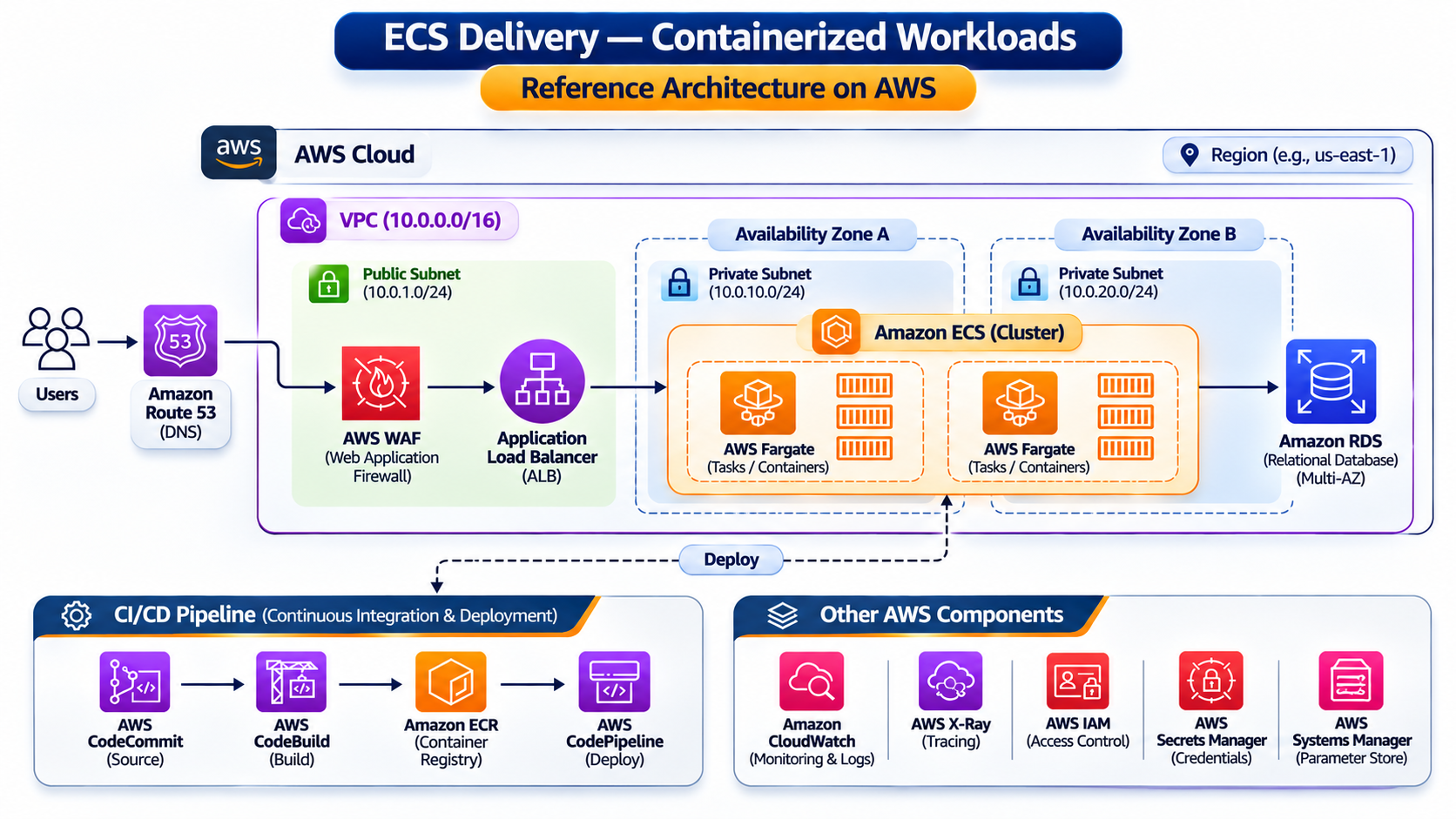
Amazon ECS solves this. Workloads are containerized with Docker, deployed on AWS Fargate or ECS on Amazon EC2, spread across multiple Availability Zones behind an Application Load Balancer, delivered through automated CI/CD pipelines, and covered by monitoring, alerting, and security controls across the full stack. The result is a platform that recovers from failures on its own, scales with demand, and can be released many times a day with confidence.
About Amazon ECS
Amazon Elastic Container Service (Amazon ECS) is a fully managed container orchestration service that makes it easy to deploy, manage, and scale containerized applications. It integrates natively with AWS services such as Elastic Load Balancing, AWS Identity and Access Management (IAM), Amazon CloudWatch, and AWS Secrets Manager. Workloads can run on AWS Fargate, a serverless compute engine that removes the need to provision or patch servers, or on Amazon EC2 capacity for teams that need GPU instances, specific instance types, or deeper host-level control.
Opportunity: Moving Beyond Fragile, Server-Bound Applications
Applications hosted on a single server, or on a fixed fleet of hand-configured servers, share the same weaknesses. They cannot scale horizontally, so capacity must be sized for peak demand and sits idle the rest of the time, or it is sized for average demand and fails under load. Any hardware fault, operating system issue, or Availability Zone disruption becomes customer-visible downtime.
Deployments on these systems are typically manual. Engineers copy artifacts to servers, restart services, and hope nothing breaks. Rolling back is slow, configuration differs between development, staging, and production, and every release carries risk. Teams compensate by releasing less often, which slows the business down.
Without centralized logging, metrics, and alerting, teams often learn about incidents from end users instead of their own systems. Organizations in this position need a way to modernize the platform without disrupting live traffic and deliver an architecture built for reliability, speed, and security.
The Solution
Assessment and Containerization
Engineers review the application architecture, dependencies, configuration, and traffic patterns, then package each service into lean, production-ready Docker images. Images are stored in Amazon Elastic Container Registry (Amazon ECR) with scan-on-push enabled, so vulnerabilities are caught before code reaches production.
Amazon ECS on AWS Fargate
Services are deployed as ECS services running on AWS Fargate, removing the dependency on individual servers and eliminating operating system patching and capacity planning. For workloads that need GPUs or specialized instance types, ECS capacity providers on Amazon EC2 with managed scaling are used instead.
High Availability Across Availability Zones
ECS tasks are spread across multiple Availability Zones behind an Application Load Balancer. Health checks automatically replace unhealthy tasks, and if an entire Availability Zone is disrupted, traffic continues to flow to healthy tasks in the remaining zones with no manual intervention.
Auto-Scaling for Elastic Capacity
ECS service auto-scaling policies scale tasks out based on CPU, memory, or request count per target, and scale back in during quiet periods. Applications absorb traffic spikes automatically while keeping costs aligned with actual usage.
Zero-Downtime Deployments
CI/CD pipelines built with AWS CodePipeline and AWS CodeBuild (or existing tooling such as GitHub Actions) build, test, scan, and deploy images automatically. Rolling updates with the ECS deployment circuit breaker, or blue/green deployments through AWS CodeDeploy, ship new versions without downtime and roll back automatically if health checks fail.
Infrastructure as Code
The full environment, including networking, clusters, services, load balancers, and IAM roles, is defined in AWS CloudFormation or Terraform. Every environment is reproducible, changes are reviewed and auditable, and development, staging, and production stay consistent.
Security by Design
Tasks run in private subnets with tightly scoped security groups and task-level IAM roles that follow least privilege. Application secrets are injected at runtime from AWS Secrets Manager or Parameter Store instead of being stored in images. AWS WAF protects public endpoints, while Amazon GuardDuty Runtime Monitoring and Amazon Inspector provide continuous threat detection and vulnerability scanning.
Monitoring and Alerting
Amazon CloudWatch Container Insights, centralized logs, dashboards, and alarms cover task health, CPU and memory utilization, response times, and error rates. Automated alerts notify the on-call team before issues escalate into customer-visible incidents, shifting operations from reactive to proactive.
Results
Higher Availability
Multi-AZ task placement, load balancer health checks, and automatic task replacement remove the single points of failure that cause outages on server-bound architectures.
Faster, Safer Releases
Automated pipelines and zero-downtime deployment strategies let teams release more frequently, with automatic rollback when something goes wrong.
Elastic Scaling Under Load
Auto-scaling policies absorb demand spikes automatically and scale in during quiet periods, keeping performance consistent without paying for idle capacity.
Lower Operational Overhead
With AWS Fargate, there are no servers to provision, patch, or replace. Engineering time moves from infrastructure maintenance to building product features.
Optimized Cost
Right-sized task definitions, scale-in policies, Fargate Spot for fault-tolerant workloads, and Compute Savings Plans keep compute spend aligned with real usage.
Stronger Security Posture
Least-privilege task roles, network isolation, runtime secret injection, image scanning, and managed threat detection give a layered, auditable security model.
Proactive Operations
Real-time dashboards and automated alerting give teams visibility into application health, so they can detect and resolve anomalies before end users are affected.
AWS Services Used
Core AWS building blocks powering high availability, elastic scaling, security, and automated deployments.
Amazon ECS
Amazon Elastic Container Service (Amazon ECS) is a fully managed container orchestration service that simplifies deploying, managing, and scaling containerized applications across Availability Zones.
AWS Fargate
AWS Fargate is a serverless, pay-as-you-go compute engine for containers. It eliminates server provisioning, OS patching, and cluster capacity management so teams focus purely on applications.
Amazon ECR
Amazon Elastic Container Registry (Amazon ECR) is a fully managed container registry that offers high-performance hosting, automated image vulnerability scanning, and IAM-governed access.
Elastic Load Balancing (ALB)
Application Load Balancer distributes incoming HTTP/HTTPS traffic across targets in multiple Availability Zones with advanced routing, health checks, and native TLS termination.
Application Auto Scaling
Automatically adjusts capacity for Amazon ECS tasks to maintain steady, predictable performance at the lowest possible cost based on target metric tracking.
AWS CodePipeline & CodeBuild
Fully managed continuous delivery and build service that automates compilation, unit testing, container image publishing, and deployment workflows.
AWS CodeDeploy
Automates application deployments to Amazon ECS with zero downtime, shifting traffic via canary or linear stages and rolling back automatically upon alert triggers.
AWS CloudFormation
Models and sets up your entire AWS infrastructure stack as code so you can spend less time managing resources and guarantee environment parity across staging and production.
Amazon VPC
Provides complete control over your virtual networking environment, including resource placement, connectivity, security groups, and private subnet isolation.
AWS Secrets Manager
Protects secrets needed to access applications, APIs, and services, offering centralized credential rotation and direct runtime injection without hardcoding.
Amazon CloudWatch
Collects monitoring and operational data across ECS tasks, delivering automated alarms, real-time dashboards, and deep Container Insights performance telemetry.
AWS WAF
A web application firewall that protects web apps and APIs against common web exploits, bots, and SQL injection without affecting application performance.
Amazon GuardDuty
Intelligent threat detection service that continuously monitors AWS accounts and workloads for malicious activity and delivers detailed security findings.
Amazon Inspector
Automated vulnerability management service that continuously scans container images and software workloads for software vulnerabilities and unintended network exposure.
Send Us a Message
Ready to bring your ideas to life? Tell us about your project and our team will get back to you within one business day.
Denver, CO 80231