AWS EKS Delivery – Scalable & Secure Kubernetes Production Platform
Amazon Elastic Kubernetes Service (Amazon EKS) gives teams a managed, highly available Kubernetes control plane, flexible compute that scales automatically, and deep integration with AWS security and networking services, so they can run containerized workloads on standard Kubernetes without operating the cluster infrastructure themselves.
Benefits
uptime, backed by multi-AZ task placement and ECS automated recovery
faster deployment speed with automated blue/green pipelines
improvement in engineering team efficiency on AWS Fargate
No Kubernetes masters or etcd to install, back up, or patch; AWS runs them
Karpenter launches right-sized nodes in seconds for pods that cannot be scheduled
Automatic use of Spot Instances and Graviton, with idle nodes consolidated away
Each pod gets its own scoped IAM role through EKS Pod Identity
Upstream Kubernetes, so existing Helm charts, manifests, and tooling work unchanged
In-place control plane upgrades with managed add-ons and automated node replacement
Overview
Many organizations adopt Kubernetes to standardize how they run containers, then find that operating Kubernetes itself is the hardest part. Self-managed clusters require teams to install, secure, upgrade, and back up the control plane and etcd, patch worker nodes, and integrate networking, storage, load balancing, and identity by hand. Upgrades are delayed because they are risky, clusters drift from best practice, and a large share of engineering time goes into keeping the platform running.
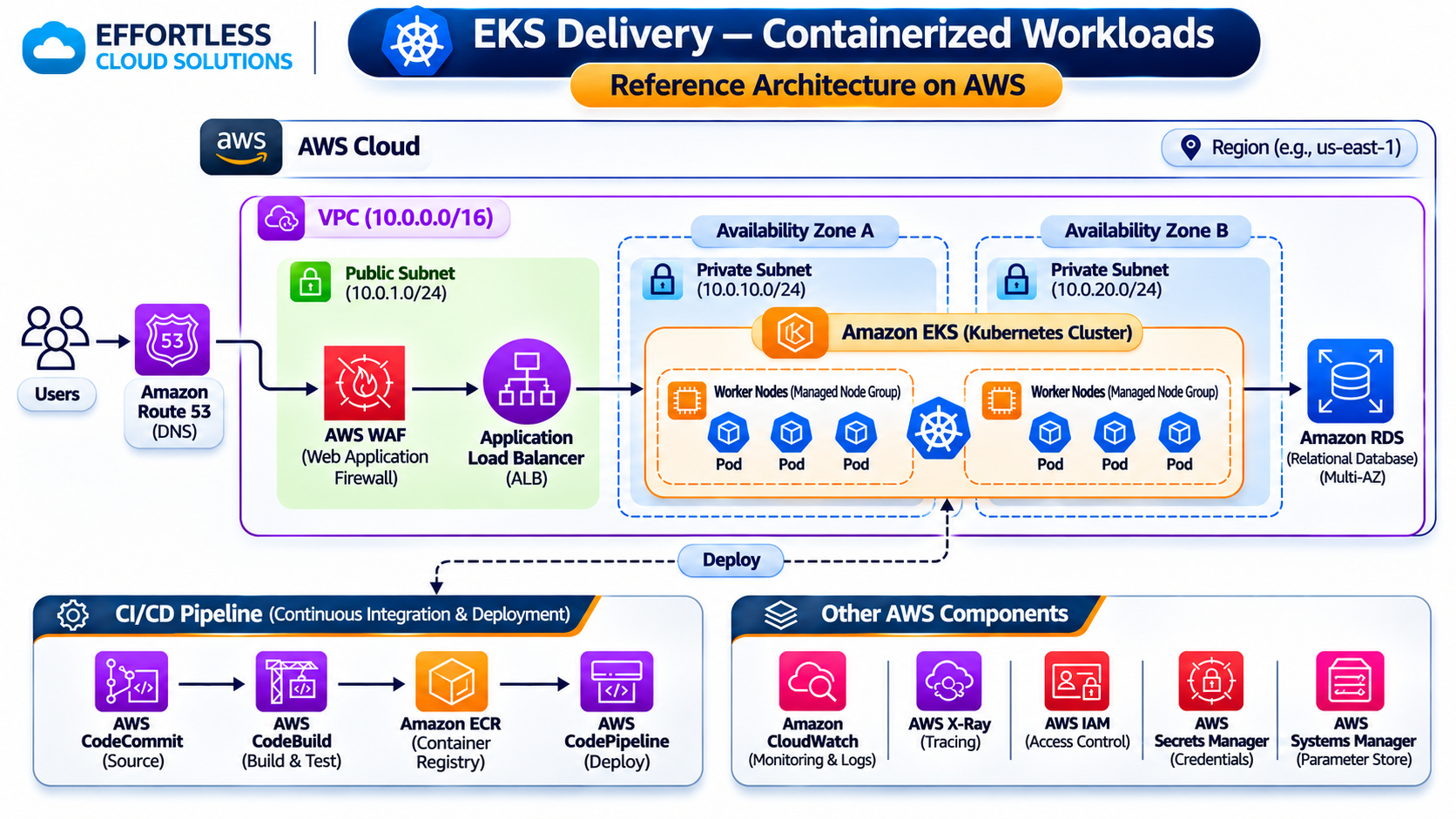
Amazon EKS removes this burden. AWS runs the Kubernetes control plane across multiple Availability Zones, while workloads run on managed node groups, EKS Auto Mode, or AWS Fargate. Karpenter provisions right-sized nodes on demand, the AWS Load Balancer Controller exposes services through Application and Network Load Balancers, and EKS Pod Identity gives each workload only the AWS permissions it needs. Clusters are defined as code, deployed through GitOps, and monitored end to end with Amazon CloudWatch and Amazon Managed Service for Prometheus.
About Amazon EKS
Amazon Elastic Kubernetes Service (Amazon EKS) is a fully managed Kubernetes service that runs certified, upstream Kubernetes on AWS. AWS operates and scales the control plane, including the API servers and etcd, across multiple Availability Zones and applies security patches automatically. Worker capacity can run on Amazon EC2 through managed node groups or Karpenter, on EKS Auto Mode where AWS also manages the nodes, or on AWS Fargate for serverless pods. EKS integrates natively with Amazon VPC, Elastic Load Balancing, AWS Identity and Access Management (IAM), AWS Key Management Service (AWS KMS), and Amazon CloudWatch.
Opportunity: Moving Beyond Self-Managed Kubernetes
Self-managed Kubernetes clusters place the full operational load on the team. The control plane must be made highly available, etcd must be backed up and restored correctly, certificates must be rotated, and every Kubernetes version upgrade must be planned and tested by hand. A single misconfigured control plane node or failed etcd member can take the whole cluster offline.
Capacity is hard to manage. Node groups are sized for peak load and sit underused, or they are sized tightly and pods stay pending during traffic spikes. Security is often inconsistent: nodes carry broad IAM permissions shared by every pod, secrets are stored unencrypted in the cluster, and there is little visibility into what is running inside containers.
Organizations in this position need a Kubernetes platform where the control plane is someone else's responsibility, compute scales precisely with demand, every workload has least-privilege access, and upgrades and deployments are routine rather than high-risk events.
The Solution
Managed Control Plane
Amazon EKS runs the Kubernetes API servers and etcd across three Availability Zones, replaces unhealthy control plane instances automatically, and applies patches. The cluster endpoint can be private, public with restricted CIDR ranges, or both, and Kubernetes secrets are encrypted with an AWS KMS key.
Network Design
The cluster runs in an Amazon VPC with private subnets for worker nodes across at least three Availability Zones, public subnets only for load balancers and NAT gateways, and VPC endpoints for Amazon ECR, Amazon S3, AWS STS, and CloudWatch. The Amazon VPC CNI gives each pod a VPC IP address, and Kubernetes network policies restrict traffic between namespaces and services.
Flexible Compute with Karpenter
Karpenter watches for pods that cannot be scheduled and launches right-sized Amazon EC2 instances in seconds, choosing from many instance types, including AWS Graviton and Spot Instances where workloads allow. It also consolidates underused nodes to reduce cost. Managed node groups host system components, and AWS Fargate profiles can run selected workloads without any nodes to manage. EKS Auto Mode is available for teams that want AWS to manage node provisioning, patching, and core add-ons as well.
Application Auto-Scaling
The Horizontal Pod Autoscaler scales deployments on CPU, memory, or custom metrics, and KEDA can scale workloads on queue depth or other event sources. Pod disruption budgets and topology spread constraints keep replicas spread across Availability Zones and protected during node replacement.
Load Balancing and Ingress
The AWS Load Balancer Controller creates Application Load Balancers for Kubernetes Ingress resources and Network Load Balancers for services, routing traffic directly to pod IP addresses. AWS Certificate Manager provides TLS certificates, ExternalDNS manages records in Amazon Route 53, and AWS WAF web ACLs attached to the ALB block common web exploits and abusive traffic.
Workload Identity and Access
EKS Pod Identity (or IAM roles for service accounts) gives each Kubernetes service account its own narrowly scoped IAM role, so pods receive only the AWS permissions they need, and nodes no longer carry broad shared credentials. EKS access entries map IAM users and roles to Kubernetes RBAC permissions, replacing manual edits to the aws-auth ConfigMap.
Secrets Management
Application secrets are stored in AWS Secrets Manager and delivered to pods through the AWS Secrets and Configuration Provider for the Secrets Store CSI Driver, or synchronized with External Secrets Operator. Secrets are encrypted with AWS KMS, rotated centrally, and never committed to Git or baked into images.
Data Layer
Application databases run on Amazon RDS or Amazon Aurora in a Multi-AZ configuration outside the cluster, so the Kubernetes platform stays stateless and database failover, backups, and patching are handled by AWS.
GitOps Delivery
Container images are built and tested in a CI pipeline and pushed to Amazon Elastic Container Registry (Amazon ECR). Kubernetes manifests and Helm charts are stored in Git, and a GitOps controller such as Argo CD or Flux applies changes to the cluster automatically. Every change is reviewed through a pull request, and rollback means reverting a commit.
Infrastructure as Code
The VPC, EKS cluster, node groups, Karpenter configuration, IAM roles, and add-ons are defined in Terraform, AWS CloudFormation, or eksctl. Development, staging, and production clusters are built from the same code and stay consistent.
Observability
Amazon CloudWatch Container Insights collects cluster, node, and pod metrics and logs. Amazon Managed Service for Prometheus stores application metrics and Amazon Managed Grafana provides dashboards, while alarms on error rates, latency, pending pods, and node health notify the on-call team before users are affected. EKS control plane logs are sent to CloudWatch Logs for auditing.
Policy and Compliance
Kubernetes Pod Security Standards prevent privileged or unsafe pod configurations, Kubernetes RBAC limits what each team can change in its own namespaces, and AWS CloudTrail and EKS audit logs record all API activity for review.
Managed Upgrades
Kubernetes version upgrades are performed in place on the control plane, followed by managed add-on updates and rolling node replacement by managed node groups or Karpenter drift. Upgrades are tested in lower environments first and become a regular, low-risk activity instead of a major project.
Results
No Control Plane to Operate
AWS runs, scales, and patches the Kubernetes control plane and etcd, removing the most complex and failure-prone part of self-managed Kubernetes.
Resilient Workloads
Topology spread constraints, pod disruption budgets, and load balancers that route only to ready pods keep applications serving traffic through node replacements and Availability Zone issues.
Elastic, Efficient Scaling
Pods scale with demand and Karpenter adds or removes right-sized nodes in seconds, so applications stay responsive during spikes and idle capacity is consolidated away.
Lower Compute Cost
Automatic instance selection, Spot Instances, Graviton capacity, and node consolidation keep compute spend aligned with what workloads actually use.
Stronger Security Posture
Per-pod IAM roles, private networking, KMS-encrypted secrets, network policies, and Pod Security Standards provide layered, least-privilege security.
Faster, Safer Releases
GitOps delivery makes every change reviewable and reversible, and the same pipeline deploys consistently to every environment and cluster.
Routine Upgrades
Managed control plane upgrades, managed add-ons, and automated node replacement keep clusters on supported Kubernetes versions with minimal effort.
AWS Services Used
Core AWS building blocks powering high availability, elastic scaling, security, and automated deployments.
Amazon EKS
AWS runs, scales, and patches the Kubernetes control plane and etcd across multiple Availability Zones with automated recovery and native AWS security integration.
Amazon EC2 (Graviton & Spot)
Elastic, cost-efficient worker node capacity utilizing AWS Graviton processors for price-performance and Spot Instances for fault-tolerant workloads.
Karpenter
Open-source, high-performance node autoscaler built with AWS that launches precisely sized EC2 instances in seconds and consolidates idle capacity to reduce cloud spend.
AWS Fargate
Runs pods directly without EC2 worker nodes or OS patching, providing container-level isolation and zero host infrastructure overhead.
Amazon ECR
Fully managed container registry with automated vulnerability scanning on push, multi-region replication, and fine-grained IAM access control.
Elastic Load Balancing (ALB/NLB)
Routes traffic directly to pod IPs via Application Load Balancers for HTTP/S ingress and Network Load Balancers for low-latency TCP/UDP traffic.
AWS WAF
Protects public-facing ALBs from common web exploits, automated bots, and rate abuse with custom rules and AWS-managed threat intelligence.
Amazon Route 53 & ACM
Automated public DNS record management through ExternalDNS and free, auto-renewing SSL/TLS certificates managed by AWS Certificate Manager.
Amazon VPC
Multi-AZ network segmentation with private subnets for pods and nodes, AWS PrivateLink endpoints, and Amazon VPC CNI native pod networking.
AWS IAM & EKS Pod Identity
Delivers temporary, scoped IAM credentials directly to individual Kubernetes service accounts, eliminating broad node-level credentials.
AWS Secrets Manager
Delivers secrets to Kubernetes pods via the Secrets Store CSI Driver or External Secrets Operator without baking credentials into images or manifests.
AWS KMS
Customer-managed encryption keys powering envelope encryption for Kubernetes secrets stored in etcd and CloudWatch log groups.
Amazon RDS (Multi-AZ)
Managed relational database tier deployed outside Kubernetes for synchronous multi-AZ replication, automatic failover, and automated backups.
Amazon CloudWatch
Centralized monitoring and log aggregation collecting EKS control plane audit logs, node telemetry, and Container Insights performance metrics.
Amazon Managed Prometheus & Grafana
Fully managed, scalable Prometheus metric ingestion and querying paired with Amazon Managed Grafana for operational visualization.
AWS CloudTrail
Records all AWS API calls and management events for governance, compliance auditing, and security forensics across the cloud estate.
Send Us a Message
Ready to bring your ideas to life? Tell us about your project and our team will get back to you within one business day.
Denver, CO 80231