Azure AKS Delivery – Secure & Scalable Kubernetes Production Platform
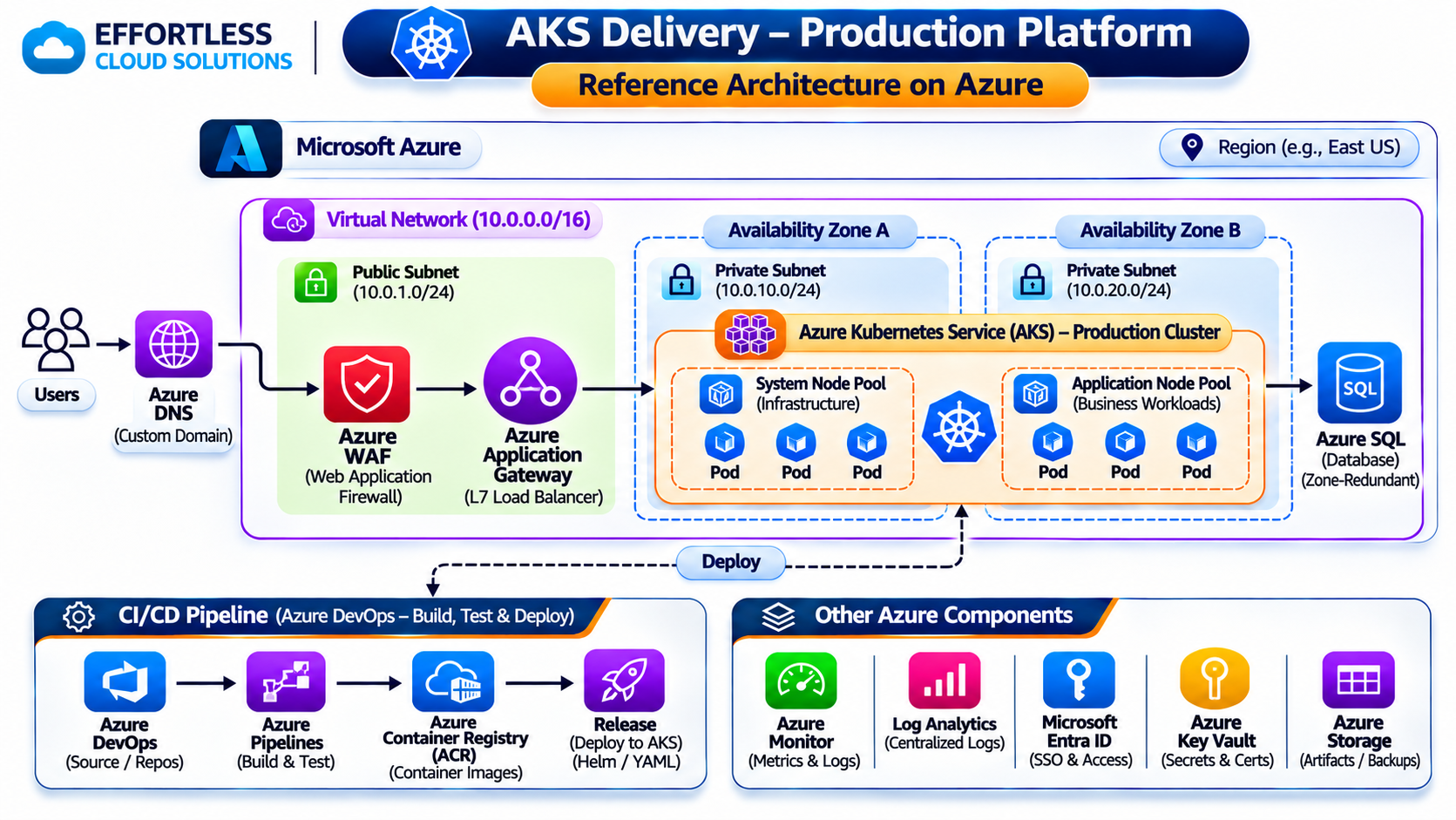
Azure Kubernetes Service (AKS) gives teams a managed Kubernetes platform for running microservices in production. Traffic enters through Azure Application Gateway with Web Application Firewall, is routed inside the cluster by a Traefik ingress controller, and is served by workloads on nodes that Karpenter-based Node Auto Provisioning creates and removes on demand. Container images flow from GitHub through Azure DevOps pipelines and Azure Container Registry, while managed identities, Azure Key Vault, and Azure Monitor keep the platform secure and observable.
Benefits
uptime, backed by multi-AZ task placement and ECS automated recovery
faster deployment speed with automated blue/green pipelines
improvement in engineering team efficiency on AWS Fargate
Microsoft runs the Kubernetes API server and etcd, so there are no master nodes to build, patch, or back up
Node Auto Provisioning (Karpenter) creates right-sized VMs for pending pods and removes them when they are no longer needed
Application Gateway with WAF protects the edge, and Traefik handles routing between microservices inside the cluster
Managed identities and workload identity replace stored credentials for pulling images and reading secrets
Every change moves from GitHub through Azure DevOps build and release pipelines into the cluster
Cluster, node, and pod health together with application telemetry in Azure Monitor and Application Insights
Overview
Teams adopting microservices often begin by running containers on individual virtual machines or self-managed Kubernetes clusters. Each service is deployed by hand, scaling means adding servers manually, and the Kubernetes control plane itself must be installed, secured, and upgraded by the team. Credentials for registries and databases are copied into configuration files, and there is no shared way to protect public endpoints or see what is happening across services.
Azure Kubernetes Service removes the heavy lifting. The platform runs inside a dedicated resource group and virtual network. Users reach the application through a domain in Azure DNS, Azure Application Gateway with Web Application Firewall inspects and forwards traffic from a public subnet, and a Traefik ingress controller in the private subnet routes each request to the right microservice. AKS manages the control plane, while Node Auto Provisioning, based on Karpenter, adds and removes worker nodes as demand changes. Azure DevOps pipelines build images from GitHub, store them in Azure Container Registry, and release them to the cluster, and Azure Monitor, Application Insights, managed identities, and Azure Key Vault provide observability and security.
About Azure Kubernetes Service
Azure Kubernetes Service (AKS) is a managed Kubernetes service in which Microsoft operates the Kubernetes control plane, including the API server and etcd, at no charge in the Free tier and with a financially backed uptime commitment in the Standard and Premium tiers. Worker nodes run in node pools backed by Azure Virtual Machine Scale Sets, and persistent volumes use Azure Managed Disks or Azure Files through built-in CSI drivers. AKS integrates with Microsoft Entra ID for cluster access, Azure Container Registry for images, Azure Key Vault for secrets, and Azure Monitor for metrics and logs. Node Auto Provisioning (NAP) is the managed AKS implementation of Karpenter, the open-source Kubernetes node autoscaler. Instead of scaling fixed node pools, NAP watches for pods that cannot be scheduled and provisions virtual machines whose size and type best fit those pods, then consolidates or removes nodes when they are underused.
Opportunity: Moving Beyond Hand-Managed Container Platforms
Self-managed Kubernetes clusters require teams to run the control plane, rotate certificates, back up etcd, and plan every version upgrade themselves. A problem with the control plane affects every service on the cluster, and upgrades are often postponed because they are risky and time-consuming.
Capacity planning is equally difficult. Node pools built around a single VM size are either too large, wasting money, or too small, leaving pods pending during traffic peaks. Exposing services publicly without a web application firewall leaves them open to common attacks, and credentials stored in manifests or pipeline variables are hard to rotate and easy to leak.
Organizations in this position need a Kubernetes platform where the control plane is managed for them, compute matches workload demand automatically, every request passes through a protected entry point, and deployments and secrets are handled without manual steps or stored passwords.
The Solution
DNS and Edge Protection
The application domain is hosted in Azure DNS and resolves to the public IP address of Azure Application Gateway (WAF v2) in the public subnet. The Web Application Firewall runs in Prevention mode with the Microsoft-managed Default Rule Set to block OWASP Top 10 attacks such as SQL injection and cross-site scripting, together with custom rules for rate limiting and blocking unwanted sources. Application Gateway terminates TLS, redirects HTTP to HTTPS, and can load certificates directly from Azure Key Vault.
Ingress Routing with Traefik
Application Gateway forwards clean traffic to the Traefik ingress controller, which runs inside the cluster in the private subnet and is exposed through an internal Azure load balancer. Traefik routes requests to the correct microservice by host name and path, and applies middleware such as retries, header rules, and per-route rate limits, so routing rules are managed with the services as Kubernetes resources.
Managed AKS Control Plane
AKS runs the Kubernetes control plane as a managed service. Cluster access is integrated with Microsoft Entra ID and Azure role-based access control, local accounts are disabled, and the API server can be restricted to authorized IP ranges or made private. Automatic upgrade channels and planned maintenance windows keep the cluster and node images up to date at predictable times.
Node Pools Across Availability Zones
A system node pool runs critical cluster components, while application workloads run on separate nodes. Nodes are backed by Virtual Machine Scale Sets and spread across availability zones, and pod topology spread constraints and pod disruption budgets keep replicas distributed and available during upgrades and node replacement.
Node Auto Provisioning with Karpenter
Node Auto Provisioning, the managed Karpenter implementation for AKS, provisions worker capacity for application workloads. When pods cannot be scheduled, it selects the virtual machine sizes that best fit their CPU, memory, and architecture requirements and creates nodes within seconds to minutes. NodePool and AKSNodeClass resources define allowed VM families, capacity types including Azure Spot Virtual Machines for interruptible workloads, and limits. Consolidation replaces underused nodes with fewer or smaller ones, reducing idle capacity, and node expiry ensures nodes are regularly refreshed with the latest images.
Pod-Level Scaling
The Horizontal Pod Autoscaler scales each microservice on CPU, memory, or custom metrics, and the KEDA add-on can scale workloads on event sources such as message queues. As pod counts rise, Node Auto Provisioning adds the nodes they need, and as they fall, it removes the spare capacity.
Persistent Storage with Azure Managed Disks
Stateful components use persistent volumes backed by Azure Managed Disks through the Azure Disk CSI driver, with zone-redundant storage options where available. Disks are encrypted at rest, and volume snapshots support backup and recovery.
Container Images with Azure Container Registry
Images are stored in Azure Container Registry. The cluster pulls images using its kubelet managed identity with the AcrPull role, so no registry passwords are stored in the cluster or pipelines.
Secrets with Azure Key Vault and Managed Identities
Application secrets, connection strings, and certificates are stored in Azure Key Vault and mounted into pods by the Azure Key Vault provider for the Secrets Store CSI Driver. Microsoft Entra Workload ID gives each workload its own federated identity with access only to the secrets it needs, so no credentials are written into manifests or images.
CI/CD with GitHub, Azure DevOps, and ACR
Source code lives in GitHub. On every merge, an Azure DevOps build pipeline compiles the service, runs tests, builds the container image, and pushes it to Azure Container Registry with a unique version tag. An Azure DevOps release pipeline then deploys the new version to AKS using Helm charts or Kubernetes manifests, with approvals and checks before production. Pipelines connect to Azure through service connections that use workload identity federation, avoiding long-lived secrets.
Monitoring with Azure Monitor and Application Insights
Container insights in Azure Monitor collects metrics and logs from the cluster, nodes, and pods, and Azure Monitor managed service for Prometheus can store Kubernetes and application metrics for dashboards in Azure Managed Grafana. Application Insights traces requests across microservices and records failures and response times. Alert rules notify the team about failing pods, node pressure, ingress errors, and slow responses.
Results
No Control Plane to Manage
Microsoft operates and patches the Kubernetes control plane, and automatic upgrade channels keep clusters current with little effort.
Capacity That Follows Demand
Karpenter-based Node Auto Provisioning adds the right nodes when workloads grow and consolidates them when demand drops, keeping performance steady while reducing idle spend.
Protected Public Entry Point
Every request passes through Application Gateway and its Web Application Firewall before reaching the cluster, and the cluster itself stays in a private subnet.
Flexible Microservice Routing
Traefik lets teams define routes and traffic rules alongside their services, without changing the edge configuration for every new service.
No Stored Credentials
Managed identities pull images and read secrets, and Key Vault holds every sensitive value, removing passwords from manifests, images, and pipelines.
Repeatable, Automated Releases
Each change follows the same GitHub, Azure DevOps, and Container Registry path to the cluster, with versioned images that make rollback straightforward.
Full Platform Visibility
Container insights and Application Insights show cluster health and request behavior in one place, so issues are detected and diagnosed quickly.
AWS Services Used
Core AWS building blocks powering high availability, elastic scaling, security, and automated deployments.
Azure Kubernetes Service (AKS)
Managed Kubernetes control plane operating master nodes and etcd with zone redundancy, automatic upgrade channels, and Entra ID role-based access.
Node Auto Provisioning (Karpenter)
Managed Karpenter implementation for AKS that provisions right-sized VMs for pending pods in seconds and consolidates idle nodes to optimize cloud spend.
Azure Virtual Machine Scale Sets
Elastic compute infrastructure backing system and application node pools across multiple availability zones with automated image re-imaging.
Azure Application Gateway (WAF v2)
L7 load balancer with integrated WAF protecting public endpoints against OWASP Top 10 vulnerabilities, performing SSL offloading, and routing to Traefik.
Traefik Ingress Controller
Open-source cloud-native ingress controller handling private subnet traffic distribution, TLS forwarding, retry middleware, and per-service routing.
Azure DNS
Highly reliable, low-latency cloud DNS hosting domain records and resolving custom domains directly to the Application Gateway public IP.
Azure Virtual Network
Logically isolated network boundaries with dedicated public subnets for Application Gateway and secure private subnets for AKS worker nodes.
Azure Managed Disks
High-performance, durable block storage mounted to pods via the Azure Disk CSI driver with zone-redundant availability and encrypted volumes.
Azure Container Registry (ACR)
Enterprise-grade private OCI container registry integrated with vulnerability scanning and credential-free AcrPull role bindings.
Azure DevOps Pipelines
Automated CI/CD workflows building Docker images, validating unit tests, publishing artifacts to ACR, and applying Helm releases to AKS.
GitHub
Centralized source code repository hosting application code, Helm charts, and GitOps configurations with automated pull-request triggers.
Managed Identities & Entra Workload ID
Passwordless authentication delivering scoped token access directly to Kubernetes service accounts without long-lived secret exposure.
Azure Key Vault
Hardware-backed secure vault storing API tokens, TLS certificates, and connection strings mounted directly into pods via Secrets Store CSI.
Azure Monitor (Container insights)
Comprehensive observability engine aggregating Kubernetes control plane telemetry, node resource pressure, and pod logs with automated alert rules.
Application Insights
Distributed application performance monitoring (APM) tracking end-to-end request latencies, dependency failures, and microservice call trees.
Send Us a Message
Ready to bring your ideas to life? Tell us about your project and our team will get back to you within one business day.
Denver, CO 80231