
Azure Front Door – Global Edge Security, WAF & Intelligent Traffic Routing
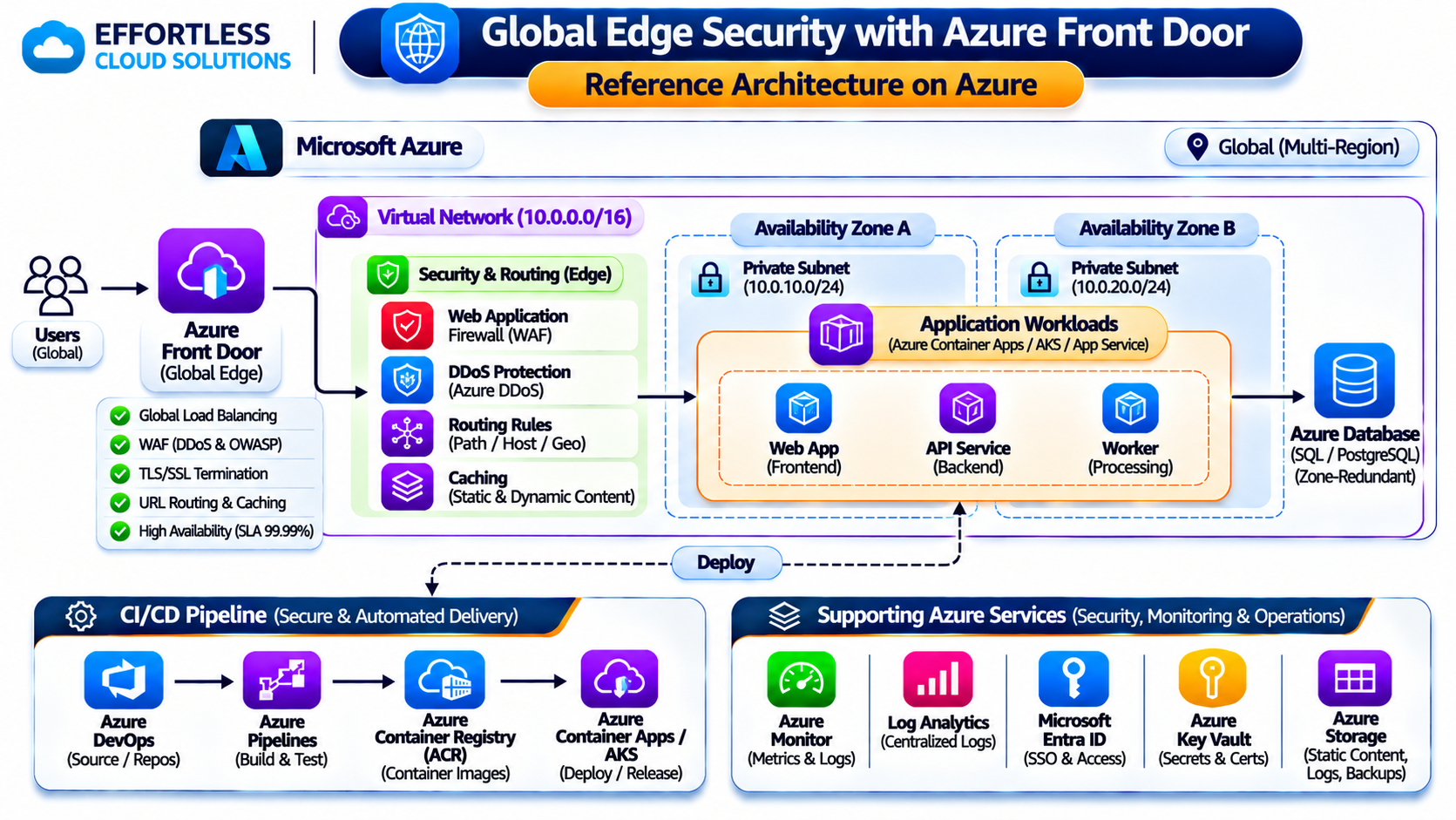
Azure Front Door places a global edge and security layer in front of web applications and APIs. It terminates TLS at the edge location closest to each user, inspects every request with a web application firewall, routes traffic to the right backend by domain and path, and keeps origin servers hidden from the internet, so applications are faster, safer, and easier to manage behind a single entry point.
Benefits
uptime, backed by multi-AZ task placement and ECS automated recovery
faster deployment speed with automated blue/green pipelines
improvement in engineering team efficiency on AWS Fargate
Users connect to the nearest Microsoft edge location instead of travelling to a single Azure region
Rate limiting, bot blocking, and custom rules stop malicious traffic at the edge before it reaches the application
Managed certificates for every custom domain, issued and renewed automatically
One entry point routes each domain or path to its own backend through origin groups
Backends accept traffic only from the Front Door profile, hiding them from direct internet access
Health probes take unhealthy origins out of rotation and send traffic to healthy ones automatically
Overview
Many web applications on Azure are published directly from Azure App Service, virtual machines, or containers. Each application has its own public endpoint and default hostname, certificates are managed separately for every site, and there is no shared layer to filter attacks or absorb traffic spikes. Users far from the hosting region experience slower page loads, and anyone who discovers an application endpoint can reach it directly, bypassing any controls placed in front of it.
Azure Front Door solves this by becoming the single, global entry point for all of an organization’s web applications. Custom domains point to Front Door, which accepts HTTPS connections at Microsoft’s worldwide edge network, applies web application firewall (WAF) policies, matches each request to the correct route, and forwards it over the Microsoft backbone network to the right origin. Origins are locked down so they only accept traffic that has passed through Front Door, and every request is measured and logged in one place.
About Azure Front Door
Azure Front Door is Microsoft’s modern cloud content delivery network and global application delivery service. It runs on Microsoft’s global edge network and combines layer 7 load balancing, TLS termination, caching, a rules engine, and an integrated web application firewall. Front Door is available in Standard and Premium tiers. The Standard tier provides content delivery, routing, custom domains, managed certificates, and WAF custom rules, including rate limiting. The Premium tier adds Microsoft-managed WAF rule sets, bot protection rules, and Azure Private Link connections to origins. Front Door works with any publicly reachable origin, including Azure App Service, Azure Container Apps, Azure Kubernetes Service, Azure Storage, and servers hosted outside Azure.
Opportunity: Moving Beyond Directly Exposed Applications
When every application is published on its own endpoint, security depends on each application individually. There is no consistent firewall in front of them, so automated scanners, vulnerability probes, and request floods reach the application code directly. Blocking a malicious source means changing settings on every application one by one.
Operations are fragmented too. TLS certificates must be bought, installed, and renewed for each site, and an expired certificate takes a site offline. Default platform hostnames are publicly visible and can leak into links and redirects, which confuses users and weakens the brand. There is no single view of traffic, errors, and latency across applications, so problems are found late.
Organizations in this position need one global entry point that applies the same security controls to every application, manages certificates automatically, routes traffic intelligently, and gives a central view of how applications are being used and attacked.
The Solution
Front Door Profile and Endpoints
A Front Door profile is created in the tier that matches the security requirements, Standard or Premium. Endpoints provide the global hostnames that receive traffic, and all configuration, including domains, routes, origins, and security policies, is managed in one profile.
Custom Domains and Managed Certificates
Each application domain is added to Front Door, validated through a DNS record, and pointed at the Front Door endpoint with a CNAME record. Front Door issues and automatically renews managed TLS certificates for every domain, or uses certificates stored in Azure Key Vault where organization-issued certificates are required. HTTP requests are redirected to HTTPS, and a minimum TLS version is enforced.
Origin Groups and Routing
Each backend application is placed in its own origin group, and routes map incoming domains and URL paths to the correct group. A single profile can serve a public website, an administration portal, and an API on separate domains, each sent to its own backend. Origin groups can contain multiple origins in different regions, with priority and weight settings for active-passive or active-active designs.
Correct Origin Host Headers
Front Door can forward either the original custom domain or the backend hostname to the origin. Forwarding the custom domain as the host header means applications generate links and redirects using the public domain rather than the platform default hostname, so users always stay on the organization’s own domain.
Web Application Firewall
A WAF policy is attached to the domains through a Front Door security policy and run in Prevention mode, so matching requests are blocked rather than only logged. Rate-limiting custom rules block any client that sends more requests than allowed in a set period, protecting against brute-force attempts and application-layer floods. Match rules block requests from known scanning and attack tools based on the User-Agent header and other request attributes. In the Premium tier, the Microsoft-managed Default Rule Set protects against OWASP Top 10 threats such as SQL injection and cross-site scripting, and the Bot Manager rule set filters malicious bots.
Origin Lockdown
Origins are restricted so they only accept traffic from Front Door. For Azure App Service, access restrictions allow the AzureFrontDoor.Backend service tag and check the X-Azure-FDID header against the profile ID, so requests sent directly to the backend hostname, or through another Front Door profile, are rejected. In the Premium tier, Private Link can connect Front Door to origins that have no public endpoint at all.
Health Probes and Failover
Front Door sends health probes to every origin at regular intervals. If an origin stops responding, it is removed from rotation and traffic goes to the remaining healthy origins in the group, with no DNS changes or manual action needed.
Performance Optimization
Static content such as images, scripts, and stylesheets can be cached at the edge and compressed, reducing load on the origins and speeding up page loads. Rule sets modify requests and responses at the edge, for example adding security headers, rewriting URLs, or setting cache behavior per path.
Monitoring and Logging
Azure Monitor metrics show request counts, latency, error rates, and origin health for the whole profile. Access logs, health probe logs, and WAF logs are sent to a Log Analytics workspace, where WAF insights show which rules matched, which requests were blocked, and where they came from. Every response carries an X-Azure-Ref header, which identifies the request in Front Door logs and confirms traffic is flowing through the edge.
Results
One Secure Entry Point
All web applications and APIs are reached through Front Door, with the same TLS, WAF, and routing controls applied consistently to every domain.
Attacks Stopped at the Edge
Rate limits and bot rules block request floods and automated attack tools before they consume application resources, while legitimate browser traffic passes through normally.
Hidden, Protected Origins
Backends no longer accept direct internet traffic, so attackers cannot bypass the WAF by calling the platform hostname.
No More Certificate Management
Managed certificates are issued and renewed automatically for every custom domain, removing manual renewals and expiry outages.
Consistent Branded URLs
Correct host header forwarding keeps links and redirects on the organization’s own domains, never exposing default platform hostnames to users.
Faster Experience for Global Users
TLS termination and caching at nearby edge locations, together with routing over the Microsoft backbone, reduce latency for users far from the hosting region.
Central Visibility
Request metrics, origin health, and WAF activity for every application are available in one place, so teams can spot errors, attacks, and unhealthy backends quickly.
AWS Services Used
Core AWS building blocks powering high availability, elastic scaling, security, and automated deployments.
Azure Front Door (Standard / Premium)
Modern cloud CDN and global load balancer terminating TLS at nearest edge locations with active-passive failover and high-availability routing.
Azure Web Application Firewall
Centralized edge protection stopping OWASP Top 10 exploits, rate abuse, and malicious bots before they consume origin compute resources.
Azure App Service
Fully managed HTTP application hosting platform running frontend web applications, backend APIs, and microservices.
App Service Access Restrictions
Network-level access control enforcing the AzureFrontDoor.Backend service tag and verifying the unique X-Azure-FDID header.
Azure DNS
Ultra-fast global DNS service hosting custom domain zones with automated CNAME record routing to Front Door endpoints.
Azure Key Vault
Secure cloud hardware security module storing custom enterprise SSL/TLS certificates with automated integration to Front Door.
Azure Private Link
Private endpoint backbone connection routing traffic securely from Azure Front Door Premium to origins without public IP endpoints.
Azure Monitor
End-to-end performance and uptime monitoring tracking global request throughput, latency histograms, and probe failures.
Log Analytics
Centralized log aggregation workspace querying blocked WAF requests, SSL cipher usage, and client geographical distribution via KQL.
Send Us a Message
Ready to bring your ideas to life? Tell us about your project and our team will get back to you within one business day.
Denver, CO 80231